Infisical
Infisical is an open-source platform for managing secrets, certificates, and encryption keys. Teams use it to store application secrets centrally and inject them into code, containers, CI/CD pipelines, and Kubernetes.
Infisical can integrate with the Securosys HSM through the PKCS#11 interface. This guide covers the two places where that applies:
- The KMS root key: the key at the top of Infisical's key hierarchy, which ultimately protects every secret, is generated and kept inside your HSM Partition.
- PKI certificate authorities: an Internal CA's signing key is generated inside your HSM Partition, and every signing operation the CA performs runs there.
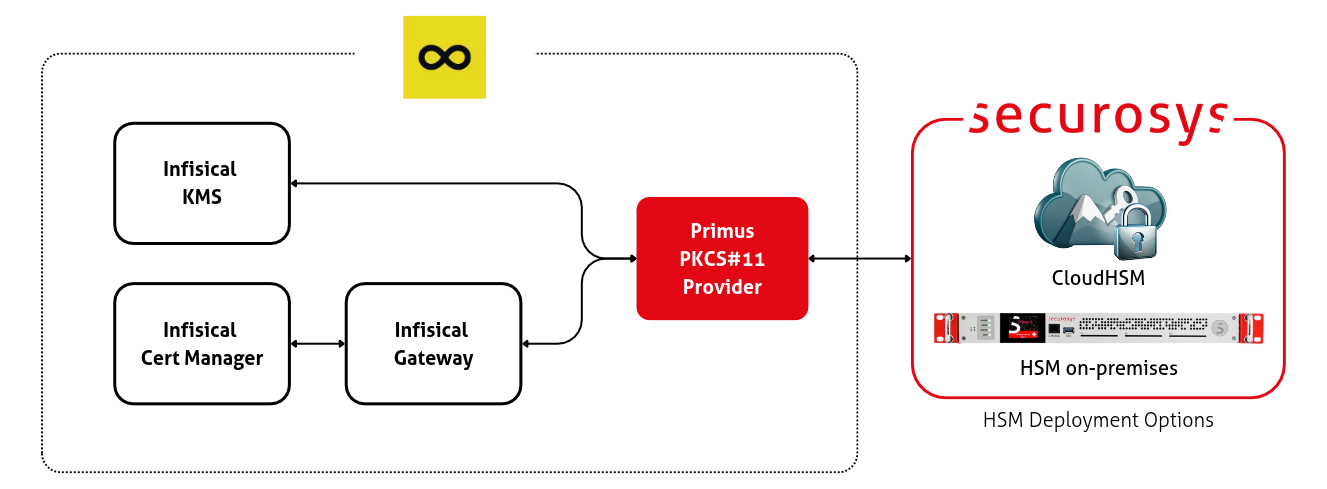
In both cases, the private key material never leaves your tamper-proof Securosys Primus HSM or CloudHSM. The two reach the HSM by different routes:
| KMS root key | PKI certificate authority | |
|---|---|---|
| Loads the PKCS#11 provider | The Infisical server itself | An Infisical Gateway on a Linux host |
| Configured through | Environment variables on the server | An HSM Connector in Certificate Manager |
| Covers | One root key for the whole instance | One key pair per certificate authority |
KMS root key
Infisical encrypts each secret with a project data key. Project data keys are wrapped by the Infisical KMS key, which is in turn wrapped by the root key in the HSM. Infisical creates two objects in the HSM Partition:
| Label | Type | Purpose |
|---|---|---|
infisical-kms-root | AES-256, encrypt and decrypt | Wraps the Infisical KMS key |
infisical-kms-root_HMAC | Generic secret, 32 bytes, sign and verify | Detects tampering with the wrapped key |
Both keys are created automatically when the encryption strategy is switched to HSM. Both are marked sensitive and non-extractable. The root key is used when the instance starts, to unwrap the KMS key. Reading and writing secrets then uses that unwrapped key in memory, so day-to-day work does not call the HSM.
For an introduction to how Infisical structures its keys, see the Infisical KMS documentation.
PKI certificate authority
For PKI, Infisical never contacts the HSM directly. An Infisical Gateway running on a Linux host in your network loads the Securosys PKCS#11 provider and relays every operation. An HSM Connector then registers one slot of your Partition with Infisical, holding its credentials but no key material.
When you create an Internal CA with Key Source set to HSM, Infisical generates the key pair in your Partition and signs the CA's self-signed root certificate, any intermediate CSRs, all issued certificates, and CRLs there. The key can be RSA-2048, RSA-4096, ECDSA P-256, ECDSA P-384, ML-DSA-44, ML-DSA-65 or ML-DSA-87. Every certificate the CA issues is signed in the HSM, so the Gateway must be reachable whenever certificates are issued.
Benefits
- Secure your keys: Keep the root key that protects all Infisical secrets, and the signing keys of your certificate authorities, inside a Securosys HSM.
- Hardware root of trust: Infisical cannot decrypt its key hierarchy without the HSM, so a copy of the database alone is not enough to read secrets.
- High availability: Deploy your Securosys HSMs as an auto-syncing, geo-redundant cluster.
- Standard interface: This integration uses the Primus PKCS#11 Provider.
Get Started
Follow the installation guide to set up your Infisical KMS or PKI with a Securosys HSM.